Weight gain and loss basis

You know, regardless of the goal, there is something in common in both cases - it is the number of calories that you consume that will be decisive.
Weight gain
It seems like everything is very simple - eat enough and grow. But our pros warn that if you eat too much, then the fat mass will also grow very noticeably, and for this reason it is advisable to know your target numbers so as not to gain too much fat
In order to understand all this, we need to learn more about such concepts as the Value of basal metabolic rate (BMR) and the Value of total daily energy expenditure (TDEE).
Basal Metabolic Rate (MBR) is the minimum recommended amount of calories to maintain the normal functioning of all body systems. If you systematically do not reach this value, then over time (after about one and a half to two month) your metabolism will be reduced in order to reduce energy consumption. In this state, the body's work will be incomplete.
Total Daily Energy Expenditure (TDEE) is the number of calories we spend during the day. This is the amount of calories needed to maintain balance. TDEE consists of Basal Metabolic Rate (BMR), activity thermogenesis and thermic effect of food. By consuming about that much, you won't gain or loose weight.
You won't be able to gain weight if you systematically do not reach this value.
To calculate value we need to use Dr J.P. Flatt formula of BMR
for men
BMR = (10*body weight in kg) + (6,25*height in cm) - (5*age in years) + 5
for women
BMR = (10*body weight in kg) + (6,25*height in cm) - (5*age in years) - 161
To calculate value of TDEE we need to determine our Coefficient of physical activity (CPA) or Physical activity level (PAL) (the same) with the help of this table.
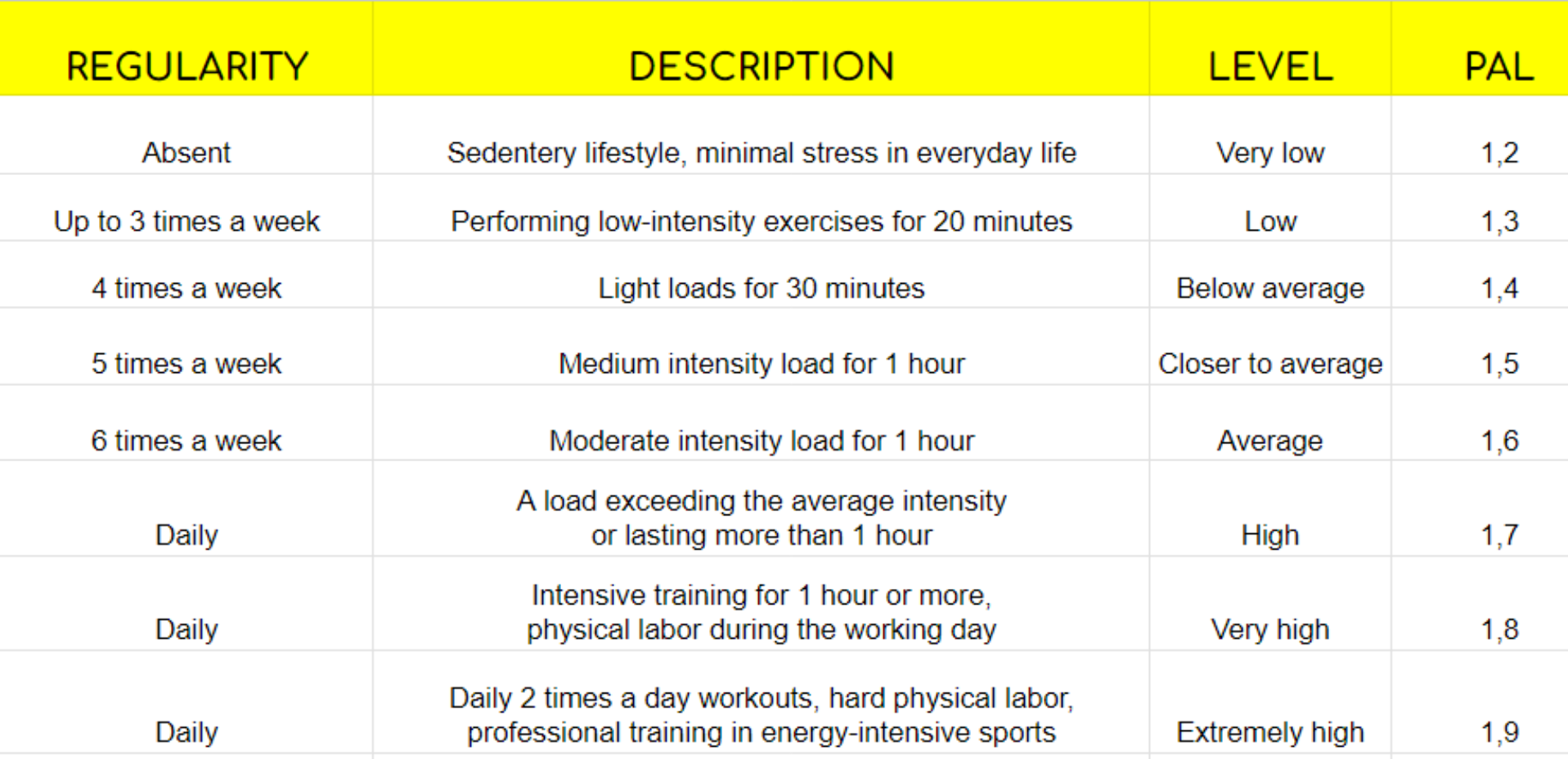
And then multiply this value (PAL) by BMR value.
TDEE = BMR*PAL
And now all that is required of you for growth is to consume more calories than the calculated number.
Weight loss
Ok, we already got the main formulas and that is great.
And to lose weight, you need to consume fewer calories than the TDEE value. But there are nuances here. As we wrote above, the amount of calories consumed should always be higher than the basal metabolic rate (BMR). Thus, the target calorie range is the value between BMR and TDEE.
Ok. Now you have the basic information to force yourself to gain weight or lose it.
But is that really all that we need to know?
Yes, if it's just about gaining and losing weight. But if it's still important to us what kind of mass we gain or lose, then of course it's important to keep the right proportions of protein, fat and carbohydrates and do workouts right (read here).
In both cases, protein should be supplied at least 1.7 grams per 1 kilogram of lean body mass (LBM), depending on the volume of power loads. And then we have to distribute fats and carbohydrates according to the remaining calories.
Carbohydrates should be at least 2.5 grams per 1 kilogram of total body weight in case of weight loss, and least 4g per 1 kg of total body weight in case of weight gain.
Fats should be at least 0.7 grams per 1 kilogram of total body weight when losing weight, and at least 1.5 grams per kilogram of total body weight when gaining weight.
Thus, it now remains for us to correctly distribute our macronutrients according to the target number of calories we have calculated.
If you don't want to bother with calculations, then we have a professional calculator for you for these purposes
Fitness Pro Calculator
or
Fitness Pro Plus Calculator
(to save data and to monitor changes using charts (body weight, fat percent, fat mass, lean mass))
And don't forget to recalculate the data every time you lose or gain 10 pounds of weight.